Over the past five decades, the United States has faced 21 federal government shutdowns, triggered by disputes over funding and legislation.
These shutdowns have varied widely in length and impact, from a single day of disruption to over a month of halted services. Below is a detailed timeline of shutdowns by administration.
1970s: Carter and Ford Era
- 1976 (President Gerald Ford): Lasted 11 days.
- 1977 (President Jimmy Carter): Three shutdowns, lasting 12 days, 8 days, and 8 days.
- 1978 (Carter): Lasted 17 days.
- 1979 (Carter): Lasted 11 days.
1980s: Reagan Administration
- 1981: Lasted 2 days.
- 1982: Two shutdowns, lasting 1 day and 3 days.
- 1983: Lasted 3 days.
- 1984: Two shutdowns, lasting 2 days and 1 day.
- 1986: Lasted 1 day.
- 1987: Lasted 1 day.
1990s: Bush and Clinton Years
- 1990 (President George H.W. Bush): Lasted 4 days.
- 1995 (President Bill Clinton): Lasted 5 days.
- 1996 (Clinton): Lasted 21 days, one of the longest at that time.
2000s–2010s: Obama and Trump Administrations
- 2013 (President Barack Obama): Lasted 17 days, over disagreements on the Affordable Care Act.
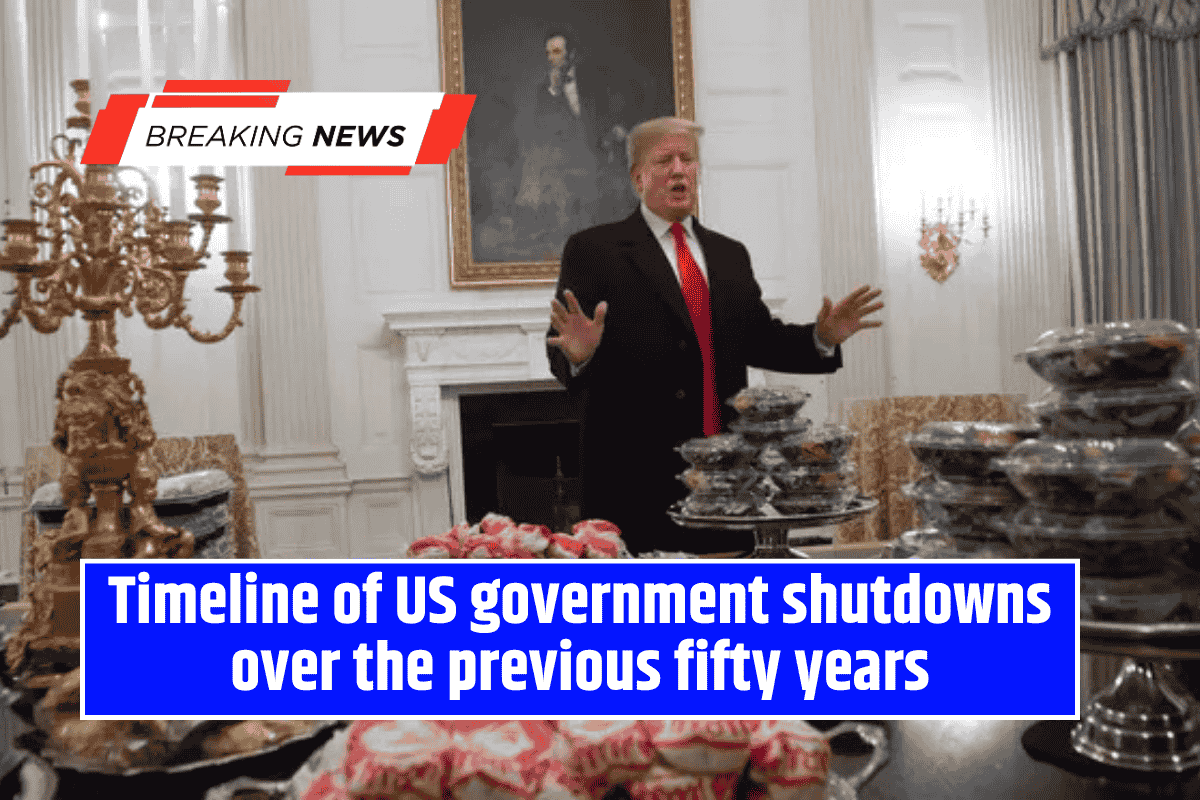
- 2018 (President Donald Trump): Two shutdowns — one lasting 3 days, another lasting just several hours.
- 2019 (Trump): The longest shutdown in U.S. history, lasting 35 days, due to a funding battle over a U.S.-Mexico border wall. It cost the U.S. economy around $3 billion (0.02% of GDP), according to the Congressional Budget Office.
Shutdowns occur when Congress and the president fail to agree on funding bills, often tied to political standoffs over broader policy issues.
While many lasted only a few days, some stretched into weeks, severely disrupting federal operations and impacting millions of Americans. The 2019 shutdown remains the longest and most costly to date.